Thursday, December 13, 2007

MY KINDA TOWN: A WEAKLY BLOW MIDWESTERN MISADVENTURE


Destination . . .

. . . CHICAGO!


A few months ago, I received an email from one Robbie Fulks, esq, a talented singer, songwriter and guitarist whom I have long admired.
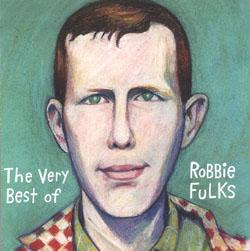
From time to time, Robbie invites various musicians to the Old Town School of Folk Music in Chicago where he puts on concerts that he later broadcasts on his XM Radio* show, "Robbie's Secret Country." His email informed me that on December 9, he intended to devote one of these concerts to the music of The Carter Family, a subject upon which I am an expert, or at least a blowhard. Would I be willing to come to Chicago to be interviewed on stage? If so, he was prepared to pay me the astounding sum of $300; and if I would condescend to appear at a second concert on the same day, the gratuity would be correspondingly doubled.

Now, talking is one of my favorite diversions and rarely do I receive this sort of encouragement, so I said 'yes' without hesitation. On December 8, I jetted to the
City of the Big Shoulders, landing at O'Hare Airport at precisely noon. Despite the cash windfall Robbie was about to lavish upon me, I was in an economical mood and made one of the greatest errors of my error-filled life: I decided to take public transportation from the airport to my hotel.

Nearly a week has passed and I am still recuperating from this ordeal, but the healing process has been hastened considerably by an exchange of emails with Alison Perona, Inspector General of the Chicago Transit Authority, which I reproduce below in its genuine entirety:

Dear Inspector General:

How are you? I am fine. I live in Boston and recently visited Chicago for the first time in many years. I decided to try your service from the airport and it was, I think, an unnecessarily distressing experience, which I know you did not intend and would not wish to see repeated.


Here is what happened: After retrieving my suitcase from baggage claim, I followed the signs to the subway and stepped up to a pass-dispensing machine to purchase a pass. I had five twenty-dollar-bills and $1.75 in change. As you probably know, the subway costs $2, so I put one of the twenties in the machine and asked it for a $2 ticket. However, the machine did not give me a ticket. It simply looked back at me as though I was stupid and reminded me that I had just given it $20, which I already knew. Fortunately, a nice man came up behind me and said: "That thing don't give change." Not being from Chicago, I reached for my wallet and pulled out a credit card, only to hear the same nice man (and he was a nice man, as you shall soon see) say: "It don't take credit cards neither." Looking about me, I saw a gaggle of out-of-towners like myself, staggering around like zombies, holding out large bills and begging Chicagoans for change. Fortunately for me, the nice man was nice enough to give me a quarter.

So here's my first question: Is it really true that your subway machines don't give change or take credit cards? Because I have lived in Boston, New York and Washington, three cities that, in many ways, have nothing on you, I'm sure, but all of which allow commuters to both use their credit cards and receive change for large bills.

Now, here's another pickle I'd like you to think about: The train ride from the airport to my hotel in Rogers Park took an excruciating two-hours-and-twenty-minutes (this is not a typo.) I spent most of the trip recalling cliches about slowness - "slow as molasses in January," "I'm coming, and so is Christmas," etc - and there were several annoying incidents along the way that dragged out the journey even further.

For instance, just three stops into the trip, we were all hustled out of the train and loaded onto a tightly-packed slow-moving shuttle bus where I was forced to listen to a very nasty man fulminate against illegal immigrants. He said that unless Mexico stopped "sending us" illegal immigrants, we should invade it and remove its leaders. Evidently, he believes this strategy is working so well in Iraq that we should try it out on other countries that threaten our security by being poor. Please find this man and waterboard him.

Anyhoo, eventually the bus rolled up to the next stop and unloaded us and we waited another ten minutes for another train that moved along at an average speed of, I'd say, 6-1/2 miles-per-hour. That train, however, was like the Georgia Mail compared to the train I transferred to, I believe on the cheerlessly-named "Brown Line." What was truly impressive was that this Brown Line train achieved extraordinary depths of slowness while skipping as many stops as it stopped at, much to the fury of my fellow passengers, most of whom were Chicagoans and probably deserve better.

So here is my second question: Is there some way that you could let me know when these various annoyances are corrected, so that I can return to Chicago under more pleasant circumstances?

Many thanks for your kind attention to these questions. I am sure you will appreciate that they are offered in a spirit of friendly encouragement.

Very truly yours, etc.


I am delighted to report that, in less than 24 hours, I received the following reply:

Dear Mr. Hirshberg,

On behalf of the CTA, I apologize for the inconveniences you experienced on your trip to Chicago.

The CTA is currently engaging in massive reconstruction and improvement projects, most notably on the Blue and Brown Lines. If you check the CTA's website http://www.transitchicago.com/, you can follow the progress of these projects.

I have forwarded your e-mail to the relevant departments so that all of the issues presented can be reviewed.

N.B. The President's authorization to use "extreme tactics" on enemies of the United States does not permit the CTA to waterboard obnoxious customers, no matter how annoying they are.

Alison Perona
Inspector General


Needless to say, I was more than satisfied with every aspect of this reply - except one, which I called to Ms. Perona's attention in a subsequent email, to wit:

Dear Inspector General:

I could scarcely have hoped for a more prompt, professional and gratifying response to my email of 12/13. However, I do wish to call your attention to one unfortunate bobble on your part. You wrote: "The President's authorization to use 'extreme tactics' on enemies of the United States does not permit the CTA to waterboard obnoxious customers." I am sure that is true, for the time being. But please note that the President's policy authorizes ENHANCED tactics of interrogation, not EXTREME ones. Waterboarding is an enhancement, not an extremity.

Nonetheless, your email has greatly enhanced my impression of Chicago in general, and the CTA in particular.

Gratefully yours, etc.

It only remains for me to recount to you, the interested reader, the remaining highlights of my visit to Chicago. On Sunday morning, I dressed in conservative blue, found the Old Town School of Folk Music and asked to be taken to Mr. Robbie Fulks, which was accordingly done. Robbie was leading a small ensemble in a song called "I've Got a Home in that Rock" and enjoying himself hugely; but the moment he turned his head in my direction, his enjoyment evaporated. It was obvious that he did not recognize me and would have been happy to continue not recognizing me for the rest of his life.

This was understandable and, indeed, typical. My appearance is such that it produces unsettling sensations in strangers, especially women. Indeed, it happens so frequently that I rarely become rattled in these situations. I was quite sympathetic to Robbie, as my face-and-figure pose particular problems to a professional entertainer who has committed himself to appearing with me on the stage. On the other hand, I had exchanged enough emails with Robbie to optimistically consider him my friend. But on another hand, I realized that I had only actually met him once, at my ex-brother-in-law's wedding seven-or-eight years ago.

"'It's me," I explained, extending my hand aggressively, "Charles 'Chuck' Hirshberg."

Had I announced myself as his blind date, Robbie Fulks could not have been more disappointed. He stared at the neck of his guitar in an agony of embarrassment as he shook my hand.

"It's been a long time," I pointed out, helpfully.

"Ya," he mumbled, "since our, um, . . . wedding."

I tried changing the subject. "Am I dressed okay?" I asked.

He looked at my clothes and snorted: "You're over-thinkin' this."

For the next few hours, Robbie energetically avoided me until it was time to invite me onstage for the interview, which went rather well, I thought. Robbie is unnecessarily tall and I am imprudently short and the audience seemed to enjoy the Mutt-and-Jeff aspect of our conversation. So at the end of the second show, when Robbie invited me on stage to sing a verse of "Worried Man Blues," I thought he had begun to accept me. I had a slight cold and sang my verse in a gruff, down-home growl that the audience applauded with great sympathy. A few days later, I wrote Robbie, asking for a recording of my performance. He replied thus:

"The channel on the mike you sang through was not turned on. You can hear your vocal a little bit as bleed through the other mikes. But mostly, you can hear me laughing sinisterly, like Eddie Murphy, through a mike that is on."

Ah, well. At least that explains the audience's enthusiastic applause: They couldn't hear me.

----------
*XM is a satellite radio service that works like this: First, you purchase a special XM radio receiver for about $600; then you pay a fee of approximately $600 a month, which may seem like a lot, but you get to listen to your choice of 46,000 channels, each of them broadcast by satellite to ensure perfect stereophonic clarity. A rival service, Sirius Radio, charges twice as much and offers only 23,000 channels, but one of them features Howard Stern. Decisions, decisions . . .
-cc-

Thursday, December 6, 2007

ANNOUNCING THE WEAKLY BLOW'S . . .


2007
MASCOT of the YEAR!
OSCAR
"New Mexico Guns' gun-toting,
left-handed, NRA-Supporting mouse"

That is Oscar's actual Official Designation - verbatim!

His motto:

"The principals of New Mexico Guns are
Christ-centered and Scripturally-focused."

English is not just the only language I know; it is the most accommodating language I know. No thought is too preposterous to be expressed in it, in a hundred different preposterous ways. So whenever I am unable to extract a sensible meaning from a sentence of English, I try to stay cool. It may take several hours of reading and re-reading but there's usually a needle of coherence to be found 'neath the haystack of jumbled words. Of course, sometimes the meaning that emerges is even more preposterous than the dross that covered it - and Oscar's motto is one of the most delightful specimens of such a sentence that I have ever discovered.

To be sure, Oscar stumbled briefly at the outset - I'm fairly certain that the word principles was called for, rather than principals. But the heart of his motto, the fervent declaration of a Christ-centered, spiritually-focused love of firearms, is spot-on and beautifully expressed. Is it not?

I am quite serious about this, a little bit. Just now, I stopped typing and saw in my imagination a great, unfathomable chasm - The Grand Chasm, I call it - that represents the philosophical distance between Oscar's human creators and me. In fact, I truly believe that I have more in common with an Irish Wolfhound of my acquaintance . . . .

SAGE
Food-focused, self-centered mascot
of
Author, Journalist, Hardly-Bitten Newswoman


New Mexico Guns, the organization that Oscar guards with such Christ-centered, left-handed vigilance, is devoted to protecting the Second Amendment to our Constitution (you know, the one that calls for "a well-regulated militia.") It does so by providing a variety of courses in the use of firearms, including "youth classes" for pre-kindergartners at a fee of $50.00 per child.

After all, did not Jesus say, whilst He walked among us: "Suffer the children to come unto Me"?

Mindful of Christ's many exhortations to charity, New Mexico Guns also offers "significant discounts to non-profit groups, such as the Boy/Girl Scouts, organized ministries, volunteer chaplain programs, or private and home schools that receive no tax support, etc."


I am certain that New Mexico Guns is a sincere enterprise. I mean, just look at Oscar - that mouse was summoned from yarn with meticulous care by someone who loved him. What amazes me is not that I disagree with its values, but that those values are completely incomprehensible to me. And evidently, that's just to be expected, for on the New Mexico Guns homepage, just a few inches beneath Oscar's portrait, reads the following:


"Oscar and our training pictures say much more (i.e., 'a thousand words') than most may initially comprehend."


Amen to that!


-cc-

Tuesday, November 27, 2007

A JOURNEY THROUGH PURGATORY . . . WITH SHAKE-SHAKE-SHAKIN' BOOTIES


In the summer of Nineteen-hundred-and-seventy-two, when I was a lad of eleven, we packed up the family Dodge and set out upon an exodus that would change my life, mostly for the worse. From Menlo Park, California, we drove 1,228.24 miles (thank you, Mapquest, for the precision) to Boulder, Colorado, there to settle ourselves in the lap of the Rockies for the next five-or-so years.

Boulder would prove to be a purgatory so horrid that, even today, the mere mention of it brings dyspepsia and, occasionally, anxiety attacks. Excuse me, here comes one now.

Okay, I'm back. Where was I?


Therapy and reprogramming have brought me to realize that Boulder actually had relatively little to do with the darkness of those years, even though the town was, at that time, basically South Park with a University plopped in the middle of it. The resemblance is so acute that once, while watching a South Park episode in which the town was destroyed by, I believe, Scientologist martians . . .


. . . I rose from my couch with ecstasy and, while dancing an evil dance and laughing an evil laugh, cried: "Ha-ha-ha-ha-ha!!! Burn, you rat-bastard southwestern Gomorrah! Burn and die!"

Like I said, though: The real problem was not Boulder. It was, first of all, my home life, which was like an episode of Supernanny, only Supernanny never showed-up; and, second, the 1970s.


I thought of the '70s recently while having a conversation with a teenage friend of mine - I'll call her Ceecee - who was having boyfriend issues and didn't know any better than to ask me for advice. After hearing her out, I told her that I had no opinion on what she should do and, if I had, I would have urged her to do the opposite, as my advice on matters of love is always bad. She seemed surprised and delighted to meet an adult who had so low an opinion of himself and began asking me questions about my youth. I told her a few of the sad stories; then I moved on to the frightening stories; and I was just getting started on the harrowing stories when she begged me to stop.

"Was it really that bad?" she asked, looking anxious and dyspeptic.

Actually, I think it was probably worse. And I decided that, whether she wanted to hear it not, I was determined to convey to my young friend just how soul-crushing American culture could be in the mid-1970s. But how to do it?

And then, a penny fell from heaven. Sarah Tisch, a very dear old friend (I mean, of course, that our friendship is old, not Sarah herself) sent me this:


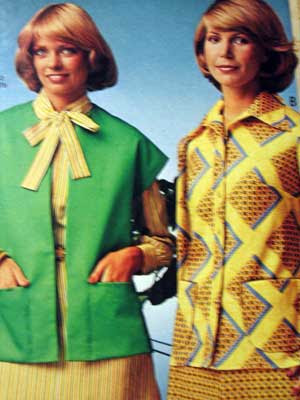
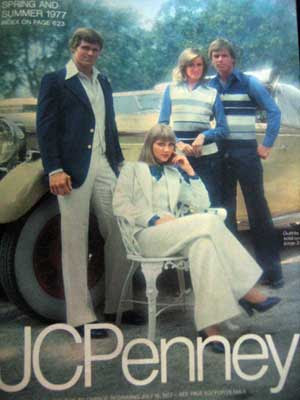
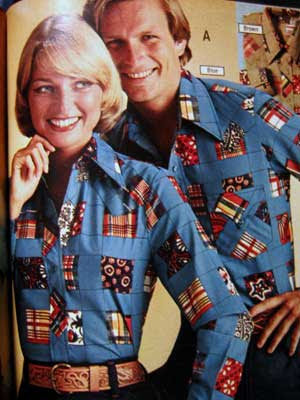
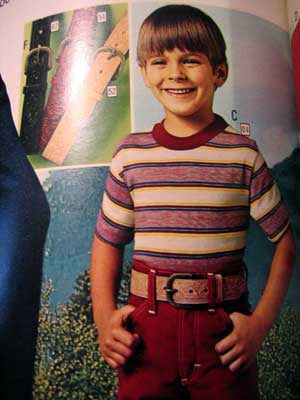
Sarah got it from her husband, Carl Bobrow, who got it from a string of forwarded messages so long that the original sender had faded into the ether. Whoever he was, here's what happened to him: One day, while installing a ceiling fan for his grandfather-in-law, he discovered the above, stashed in the eaves - J. C. Penney's catalogue of the Seven Storey Mountain between heaven and hell, where the souls of the wicked are cleansed by suffering.

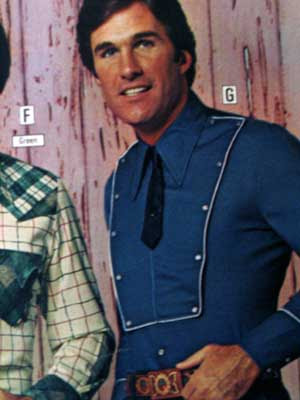
My own personal cleansing began in earnest when I was a juvenile delinquent who occasionally attended Boulder High School. I looked like this . . .


. . . at a time when it would have been more expedient to look like this:


Now, please don't misunderstand me: I'm not suggesting that the '70s was a wicked era because everybody dressed-up like nimrods. (Look at my thrift-store shirt, for Crissake.) It was a wicked era because of its relentless obsession with conformity.


It was especially hard on young people who defied the expectations of their parents and communities. Nowadays, the Internet functions like a periscope with which a kid can catch glimpses of the entire planet and fact-check the threatening remonstrations of a parent or teacher. We had none of that, so it was much easier for authority figures to terrorize us, if they chose. All an adult had to do was discover an adolescent’s deepest wish and then assure the poor kid that he’d never get it unless he behaved in whatever way the adult wanted him to behave. Even the most spirited kid could be beaten down with threats about what awaited him in the outside world – I saw it many times.


Thank God, it is now virtually impossible to alienate a young person the way we could be alienated. As long as a kid can find her way to a computer, she can roust-up an online community that shares all of her own peculiarities – however peculiar those peculiarities may be. But in the ‘70s, each individual misfit or weirdo was assured that he or she was the only person on earth who didn’t want to be “normal.” And the spectacular advantages of being normal were hammered into us all day long – by our cereal boxes, by our teachers, by our parents and, of course, by all five channels on our television sets.


In the ‘70s, you displayed your oddities at your own risk – sometimes, at risk of life-and-limb. I will never forget when one of my best friends got drunk, confided to me that he was gay and sobbed with relief when I told him I didn’t give a shit. A month-or-so later, he took me to a gay bar in Denver. We drove through the sleaziest part of town – West Colfax, I believe – and parked in an unlit lot behind a completely dark abandoned factory building. Then we walked down a short flight of stairs to a landing where half-a-dozen musclebound biker types guarded the door. They waved us inside and suddenly, I found myself on the set of Saturday Night Fever, except everyone was male. It was exactly like visiting a speakeasy.


I showed these pictures to Ceecee and we had a long, bonding conversation (though I almost punched her in the neck for calling my high school girlfriend a "ho.") But one historical detail puzzled her: Hadn't the '70s been preceded by the '60s, a time of youthful rebellion, politicking, drug-taking and non-stop rutting?

Well, yes. And for many of us, its pathetic remnants were a particularly dispiriting sign of futility. I remember two kinds of ex-hippies, principally: Those who had completely thrown-in the towel and gotten their real estate licenses; and those who sat around their cheerless apartments treating their hangovers with bong-hits. Both species would reminisce insufferably about their anti-establishment pranks, their immense moral courage and all that they’d done to “change the world.” It could be very embarrassing to listen to them. They were like those guys you so often meet in sports bars, bragging boisterously about all the women they’ve bedded – too thick and too drunk to realize that everybody in earshot knows they are, you might say, exaggerating.

Of course, this whole post is an exaggeration. Nothing in the past is entirely as we remember it and I have deliberately forgotten far, far more about my adolescence than I remember. But I can tell you this: I thank God, if She's out there to be thanked, that bright, spirited, beautiful Ceecee waited until 1990 to enter the world.


-cc-

Friday, November 16, 2007

BELTWAY BEAUTIFICATION (Or: Is it true what they say about our nation's capital?)


Recently, I was forced to leave the haven of home for a fortnight's journey to the City that Loves to Serve - Washington, DC. I used to live and work in the District, way back in the Reagan era, which, despite my memories of it, was apparently a Golden Age of prosperity and freedom. So much so that Washington has re-named its only endurable airport after the star of Girls On Probation.


While in Washington, I had several hair-raising adventures that reminded me of younger and happier days, when I was a bright-eyed bushy-headed gofer at the Washington Post Magazine. For instance, during a visit to the National Archives, a security officer gave me the business for endangering the security of the reading room by trying to enter it while wearing a baseball cap. I never found out if my hat was feared as a potential terrorist, or whether the Chief of Archives suspected that it might attempt to steal documents by concealing them under its brim. If the former, perhaps, in future, security officers could simply search hats for guns, knives and explosives - a procedure that would take no more than a quarter-of-an-hour, even in Washington. If the latter, I would think that my hat would be no more likely to conceal documents than my shirt or my underpants, both of which were allowed to enter the reading room without intereference.

That afternoon, as I walked back from the Archives to my cousin's house in Georgetown, I came across the following sign on M Street:


Ha, ha, ha, I thought to myself. There's Washington in a nutshell: The Municipal Beautification Department oblivious to the Department of Public Thoroughfares; an admonition for caution, incautiously obstructed. Ha, ha, ha.

Unfortunately, the ha-ha-ha's quickly gave away to consternation. All up-and-down M Street, and a quarter mile up Wisconsin Avenue, nearly all cautionary signs were obstructed in the same way.

Like the Bush Administration in Iraq, the municipal government of the District of Columbia has thrown caution to the wind.

-cc-

Tuesday, November 13, 2007

MASCOTS of the MONTH

Remember when you were a kid and you fell off your bike, face-first, smacking your mouth on the pavement? Remember what that tasted like? Well, that's the flavor of GRIDIRON GLORY!

Hirsh Horn's Weakly Blow is sending out a big, appreciative tom-turkey SQUAWK!!! to a pair of football mascots who never tire of smashing their mouths for their schools. That's the kind of pathological obsession it takes to spell V-I-C-T-O-R-Y. These cross-dressing exhibitionists put the "it" in "spirit" and the "oot" in "root." And you'd better believe they know . . . there's no "I" in "MASCOT."

First, let's bow our heads and say pre-victory grace over . . .


'SENATOR SNAFU'
THE EDIBLE BABY

Smuckhill Junior College Screamin' Eagles


Now let's have a fearsome Weakly Blow hellfire holler for . . .


'WILD OSCAR'
THE OPENLY-GAY
NEAPOLITAN MASTIF
GRIZZLY BIBLE INSTITUTE DANCIN' DOGS

Congratulations to November's sacrificial mammals! No turkey can touch you!


-cc-

Monday, November 5, 2007

'GOOD QUESTION, AMBER!' A Weakly Blow White House Adventure

[NOTE: The members of the West Boston Irish Drunkards Society - a fraternal organization which, despite its name, exists only to torment me - made clear their opinion of the Weakly Blow on the second day of its life: "Your blog is an abomination," they wrote to the editor, "and you are ugly and short." These anonymous cowards (they maintain their anonymity by never removing their faces from behind their humongous beer mugs, even when visiting the men's room) have once again risen from their alcoholic stupors to render the following judgement: "Dear Editor: 'Good Question Amber!' is the most a bominable [sic] post ever posted on yr a bominable [sic again] blog. But that is only because it is the longest. Very truly yours, etc." Unfortunately, the Drunkards are not altogether wrong in this instance. It is a touch long but I am not talented enough to trim it, nor humble enough to kill it. Proceed at your own risk and cease reading if your skin busts out in hives. Hirsh Horn's Weakly Blow cannot be resbonsible for rashes induced by poor writing, or by anything else. - cc]

David Almacy
Former White House Internet Director
Photo: Courtesy of the White House

A few weeks ago, I read in the always-informative-and-amusing Boston Globe that the President had initiated a Bold New Initiative aimed at solving the problem of "climate change," which is what Republicans call "global warming." To me, climate change is an important topic, because I got a kick out of March of the Penguins and I'm a sucker for baby harp seals and I enjoy having non-cancerous skin. But as noted in a previous post, the Boston Globe isn't always spot-on when it comes to seeing something, writing down what was seen, and then publishing a comprehensible account of the whole affair. So instead of relying on the Globe, I went to a website I knew I could trust - www.whitehouse.gov - to find out exactly what The Decider had decided to do. The answer was, I confess, disappointing, for the Bold New Initiative turned out to be . . .

. . . a speech.

Now, as everyone knows, a speech is better than nothing, except, I guess, this time, when it wasn't. It was fairly long - more than twenty minutes - and seemed even longer because of some unnecessary padding. Here are a few actual excerpts, guaranteed utterly genuine:

"Every day energy brings countless benefits to our people. Energy powers new hospitals and schools so we can live longer and more productive lives. Energy transforms the way we produce food . . . Right now much of the world's energy comes from oil. . . . Almost all our vehicles run on gasoline or diesel fuel."

Evidently, times have grown so tough at the White House that either President Bush's speeches are being written by a fifth grader, or he is writing them himself. I half-expected him to say: "My daddy has a big red car that can go real fast - brrrr-OOOM! And daddy's red car drinks gas that gots no lead in it."

But he did not. Instead, he said this:

"There is a way forward that will enable us to grow our economies and protect the environment and that's called technology."

I read that sentence over a few times; then I read the whole speech over again. All of that reading took about three-and-a-half minutes, because I read very slowly. Then I took another three-and-a-half minutes to think a little bit, but I had to stop because thinking makes me queasy - almost as queasy as that sentence: "There is a way forward . . . and that's called technology."

In the first place, "technology" is a noun that pines for some sort of a verb. I've got nothing against nouns - "penguin," "seal" and "skin," for instance, are all nouns. But when someone, especially the President, initiates an initiative, a noun can't do the job alone.

Consider this: if President McKinley had relied on nouns alone, we might never have been able to have the Spanish-American War. The initiative behind that war was: REMEMBER THE MAINE! People started yelling that initiative at other people, so loudly, and so frequently, a lot of guys probably went off to war thinking that Spain had blown up Maine itself. That's how you know a Bold New Initiative is working: People start acting even stupider than they really are. But supposing McKinley had stood before Congress and said: "There is a way forward that will enable us to take Cuba and the Philippines and, incidentally, Guam, away from Spain - and that is called Maine."

Doesn't work, does it?

There could be a deeper problem here, too. I like technology as much as the next guy. Without technology, you couldn't very well take cameras up to the North Pole and follow penguins around, could you? But there was a particular way in which we humans kick-started this whole "climate change" thing . . . and that was called technology.

So I decided that it was my editorial duty to put these concerns to the proper authorities, which, in this case, meant President Bush and his wife, Laura. I realized that it might be necessary to climb a few rungs up the bureaucratic ladder before a face-to-face meeting could be arranged, but where better to start than
www.whitehouse.gov? Sure enough, a few clicks of the "search" function and I was directed to . . .


Here was a page where citizen journalists like me could engage in constructive dialogue with America's most powerful, non-partisan public servants. Before engaging, however, I decided to "lurk," as we bloggers say, reading a few of the questions that other citizen journalists had previously put before the White House. Question # 1:

Question, Amber from Eaton: George W. Bush is what number as President of the U.S.?

Answer, David Almacy, Former White House Internet Director: Good question, Amber. President George W. Bush is the 43rd President of the United States. His father, George H.W. Bush, is the 41st. In fact, the order of U.S. Presidents is the source of one of my favorite trivia questions. As previously stated, President Bush is 43rd, but there have only been 42 men to serve as President. Why the difference? The answer is because Grover Cleveland is the only man to serve two terms, non-consecutively. . . .


It goes on from there, for a long time, which is understandable, I guess, since it's the source of one of David's favorite trivia questions. But, to my mind, it raised a couple of additional trivia questions. First, what does Amber have against the encyclopedia? Second, if her question was a good one, what constitutes a bad one?

I tried scrolling down to examine the rest of the questions, but I hadn't scrolled long before I found there was nowhere left to scroll. Evidently, Amber's question was so good, all other questions have been removed from White House Interactive and David Almacy has been relieved of his cumbersome responsibilities. Not a single question has been asked since Amber asked hers on March 26, 2007 10:57 a.m.(EDT)

Sheesh, I thought to myself, nearly everyone in America must have read Amber's question by now, and David's answer, too. Had White House Interactive really ceased interacting? This seemed unfair - a thought which surprised me because I didn't realize the White House was capable of being unfair. But then - aha! - I noticed that at the top of the page, there was a hot link, urging me to
SUBMIT A QUESTION. So I did, to wit:

Dear David Almacy, Former White House Internet Director,

How are you? I am fine. Here is my question: It seems that no questions have been asked or answered on "White House Interactive" since Amber's good question got the star treatment back in March. Wassup with that? Has this service been discontinued? If so, why? And to whom should I complain about it? I am a very skilled complainer and maybe I can get you your job back. Yours, patriotically,
Conrad Coleridge, Brass Castle, NJ

To my immense surprise, I received an answer from David almost immediately:

Thank you for your input.

I wasn't aware that I'd put anything in and wondered where I'd put it. But at least the White House, through David Almacy, expressed its position with uncharacteristic swiftness and precision, even if that position seemed a little more guarded than I felt was necessary.

So, to David Almacy, wherever you are, I am happy to say . . .

You're welcome!


Friday, November 2, 2007

HELLO TO THE FLOWERS


My uncle, Richard Feynman, used to say this a lot:

"I have a friend who's an artist, and he sometimes takes a view that I don't agree with very well. He'll hold up a flower and say, 'Look how beautiful it is!' and I'll agree. Then he'll say, 'I, as an artist, can see how beautiful a flower is. But you, as a scientist, take it all apart and it becomes dull.'

"I think he's kind of nutty.

"First of all, the beauty he sees is available to other people, and to me. Although I may not be as aesthetically refined as he is, I can appreciate the beauty of a flower. At the same time, I see much more about the flower than he sees. I can imagine the cells in there, the complicated actions in there, which also have a beauty. There's not just beauty at this dimension of one centimeter. There's beauty at smaller dimensions - the inner structure. Also, the processes: The fact that the color of the flower evolved in order to attract insects to pollinate it is interesting: It means the insects can see the color! It adds a question: Does this aesthetic sense also exist in lower forms? All kinds of interesting questions that only add to the excitement and the mystery and the awe of a flower! "

I saw something today that made me think of all of this, but before I show you what it was, I must ask you to consider the beauty of the Browneyed Susan (Rudbeckia triloba) . . .


. . . a flower that always reminds me of my sister, another beautiful Browneyed Susan. But forget her for a moment (sorry, Sis.) Keep thinking of that flower, if you can, while thinking about this: Uncle Richard also introduced the world to
nanotechnology in a speech he gave in December of 1959. See the connection?


No, probably not.


Well, take a look at this:


See what I mean? The orange photograph - more accurately a "photomicrograph" - was taken by Ghim Wei Ho, a Ph.D. student of nanotechnology at Cambridge. It shows "a 3-D nanostructure grown by controlled nucleation of silicon carbide nanowires on Gallium catalyst particles." If, for some reason, you want to know what that actually means, there's an explanation here. But why bother? I mean, why take it all apart and make it all dull? ;-)


I doubt that even Uncle Richard could have imagined that flowers not only contain beauty in many dimensions (so to speak) but exist in many dimensions! On the other hand, I doubt that he would have been surprised.


Jesus, I miss my Uncle Richard! And in this, I gather, I'm not entirely alone.

- cc -


Fine print: The photomicrograph is ©Ghim Wei Ho and Prof. Mark Welland, Nanostructure Center, University of Cambridge. The Browneyed Susans are © Me - all rights protected by my platoon of sleazy lawyers.